Community has significantly shaped the global HIV response since 1981, advocating for government action, increased representation in clinical trials, and access to treatments. Community voices are integral to ethical research in sexually transmitted blood-borne infections (STBBIs). At the CTN+, community involvement has been central since 1990, formalized by the Community Advisory Committee (CAC) established in 1992 to provide formal input, reviewing over 400 trials with more than 70 members. With the renewal of the network, now known as CTN+, former CAC members transitioned to a new Community Leadership Team (CLT), an advisory body which now guides research, decision-making, and mentorship, while CAC focuses on study review and knowledge mobilization.
The purpose of the CAC
The CAC is a diverse group of individuals from across Canada who are living with HIV and/or STBBIs or represent other organizations working to find new preventions, treatments, and cures. combat this pandemic. Members review research proposals and informed consent forms, provide recommendations to the Network’s Steering Committee, and participate in knowledge mobilization activities such as advising on study recruitment and public-facing materials and outputs from the studies.
CAC members also act as informal knowledge brokers, connecting people living with and impacted by HIV and/or STBBIs to Canadian researchers, fostering collaboration, representation, and participation in CTN+ research.
Members attend and contribute to virtual and in-person CTN+ meetings by sharing input on concepts, suggesting research ideas, and discussing community priorities and perspectives. They advise on recruitment strategies for specific studies, collaborate with the Knowledge Mobilization Hub to effectively share the results of CTN+ research. Some members also choose to join research teams aligned with their personal interests.
CTN+’s renewed vision highlights the importance of community engagement from the very beginning of the research process — identifying research priorities, developing research questions, designing protocols, and implementing projects, as well as disseminating results.
CLT Co-Chair, Rico Mandarino, whose work with CTN+ spans across committees, studies, and knowledge mobilization, credits this vision and the community’s role within the CTN+ as his motivation for joining the Network.
“The role of the CAC goes far beyond protocol review,” he says. “They ensure marginalized voices are included, heard, and respected throughout the research process. By incorporating lived experience at every stage, the CAC ensures research remains relevant and keeps scientists connected to the ultimate impact of their work.”
Why join the CAC?
As a CAC member, you will contribute to improving the understanding, prevention, and treatment of HIV and STBBIs, while championing the importance of community involvement in research. Your voice can bring new ideas and perspectives.
CLT member Darren Lauscher, who has been part of the Network since 2018, finds some of the most rewarding aspects of his community leadership role to be the ability to link people together, surprising CTN+ senior leadership with our network of contacts, the quiet acknowledgement from persons you have mentored, and when you hear back from others the acknowledgement of a job well done. Membership offers additional benefits, including learning and networking opportunities. Some available training and activities include:
• Access to the upcoming CTN+ Community Science Champion Program
• Orientation sessions for new members before the CTN+ annual meetings
• Regular presentations by research experts
• Workshops and capacity strengthening in knowledge mobilization
• Online modules on Good Clinical Practice and more
• Compensation according to the CTN+ Community Compensation Guidelines (created by community, for community)
The CAC takes pride in empowering its members through mentorship, leadership, and advocacy training in a supportive peer environment aimed at dismantling inequitable power structures.
Are you interested in joining the CAC? Click here
With the new CIHR grant shifting CTN+ priorities on a regional and national level, there’s a growing need for more diverse representation in the CAC. Which is why we’re currently inviting applications for new members to ensure the committee reflects Canada’s diverse regions and populations most impacted by HIV and related health issues. Ideal candidates should be interested in HIV/STBBI treatments and research, understand issues pertinent to their communities, and be proficient in English (French speakers are also encouraged to apply). No prior scientific experience is required, as training will be provided.
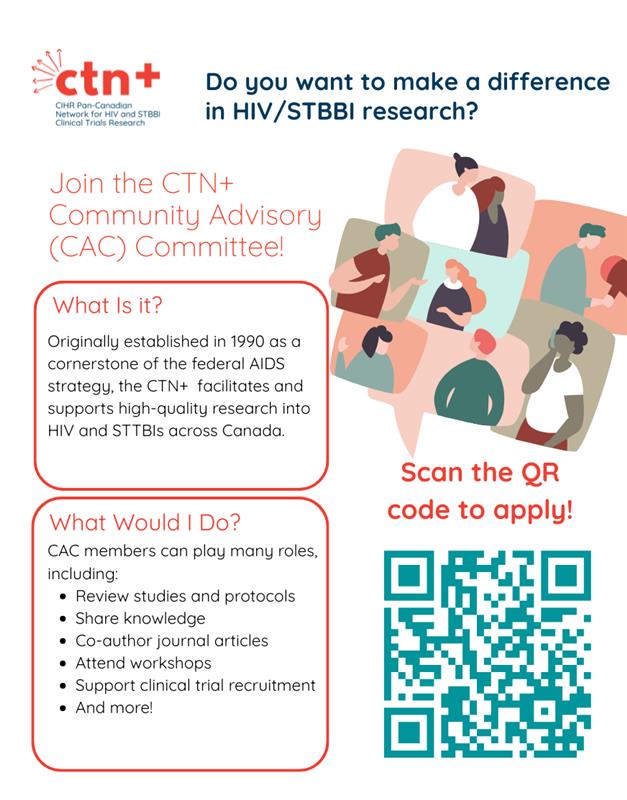
To apply to join the CAC, we’re inviting interested applicants to reach out to Jaydee Cossar, CTN+ Community Engagement Manager at info@ctnplus.ca to request the application form. Each application will be viewed by a selection committee made up of CLT members, ensuring the process is “by peers, for peers”. Successful applicants will be invited to a CAC orientation session, provided with documentation, background information, and more.
Looking to the future
For science to be relevant, applicable, and timely, people with lived and living experience and other community members must be engaged throughout the research continuum.
“Our evaluation of previous community engagement mechanisms has contributed to the design of a renewed governance structure, including specific community spaces that provide strategic guidance to the CTN+ and wider integration of people with lived and living experience, and other community members into all activities and leadership roles,” summarized Jaydee.
Community-led leadership shapes ethical policies and practices, helps set research priorities, and improves the quality and impact of research efforts. Continuous diversification of our community representation is key to continuing the momentum built up over three decades of research. If you are living with HIV and/or STBBIs and want to make a difference, your voice belongs here.